


Informational nature
The information presented in this text is scientific and educational in nature. It is intended to describe molecular, cellular, and systemic biological processes.
This text does not address specific pharmacological interventions, clinical indications, or therapeutic outcomes. The information is provided to support a general understanding of physiological mechanisms, based on peer-reviewed scientific sources.
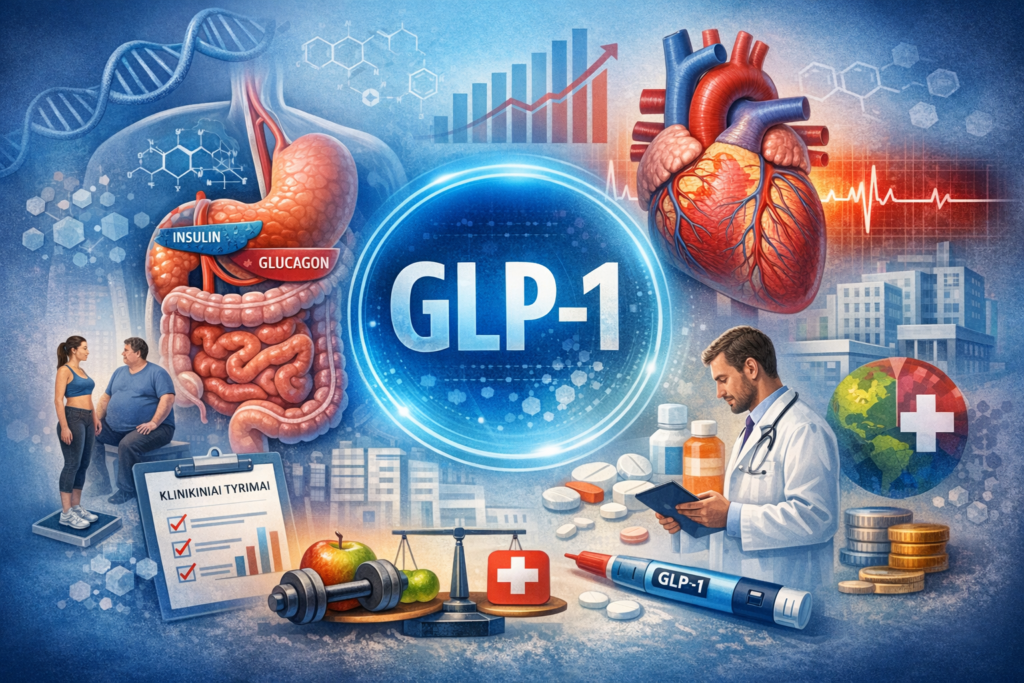
Glucagon-like peptide-1 (GLP-1) is a gut-derived hormone belonging to the incretin group [1,2]. It is released in response to food intake and plays a regulatory role in metabolic signaling processes.
The incretin effect describes the phenomenon whereby orally ingested glucose elicits a greater pancreatic secretory response than intravenously administered glucose at comparable blood glucose levels [1,2]. GLP-1 is one of the key signaling molecules underlying this effect.
GLP-1 is synthesized in enteroendocrine L-cells of the small intestine and is released in response to nutrient entry into the gastrointestinal tract [1].
Keywords: GLP-1; incretins; glucose homeostasis; energy balance; satiety signaling; gut–pancreas axis; clinical research methodology
Historical background
The concept of incretins was introduced in the early 20th century following observations of functional interactions between the intestine and the pancreas.
Subsequent biochemical research led to the identification of specific gut hormones, including GLP-1, as key contributors to the incretin effect [1,2].
Following the characterization of the GLP-1 receptor and its signaling pathways, research expanded to encompass molecular, genetic, and systemic approaches to investigating the role of this hormone across different tissues [2,3].
Molecular structure and receptor
GLP-1 exerts its effects via the GLP-1 receptor (GLP-1R), a member of the class B G protein–coupled receptor (GPCR) family [2,3].
Receptor activation stimulates adenylate cyclase activity, resulting in elevated intracellular cAMP levels and subsequent activation of downstream signaling cascades [2,3].
GLP-1R expression has been identified in:
- pancreatic β-cells,
- gastrointestinal tissues,
- specific regions of the central nervous system,
- other metabolically active tissues [1–3].
Key physiological mechanisms
1. Modulation of secretory processes
GLP-1 is involved in the modulation of glucose-stimulated pancreatic secretory activity. This process is dependent on glucose levels and metabolic context [1,2].
Signaling is associated with cAMP/PKA pathways and changes in ion channel activity [2,3].
2. Regulation of glucagon secretion
The effects of GLP-1 on pancreatic α-cells are described as context-dependent and influenced by metabolic state [1,2].
3. Gastrointestinal motility
Activation of GLP-1 receptors is associated with the modulation of gastric emptying rates [1], thereby influencing nutrient absorption dynamics.
4. Central nervous system aspects
GLP-1 receptors are expressed in the hypothalamus and other brain regions involved in energy balance signaling [2,5].
Experimental models investigate the role of these pathways in the central regulation of energy balance and feeding behavior.
Methodological context
GLP-1 biology is studied across multiple levels:
- the molecular level,
- cell culture models,
- animal models,
- human physiological observations [1–7].
Interpretation of results depends on:
- study design,
- model selection,
- population characteristics,
- statistical methodology.
Physiological hormonal signaling and data derived from experimental models are not directly equivalent; therefore, their interpretation requires careful contextualization.
Research directions
Current research focuses on:
- molecular mechanisms of receptor signaling,
- tissue-specific expression of GLP-1R,
- interactions between signaling pathways,
- variability in individual biological responses [2,6,7].
These research directions aim to advance the understanding of integrated hormonal regulatory systems.
Discussion
The GLP-1 system represents a complex hormonal regulatory network involving interactions between the gut, pancreas, and central nervous system.
Mechanistic studies indicate that the effects of GLP-1 depend on metabolic state, nutritional conditions, and concurrent hormonal signals. As such, the analysis of a single signaling pathway may not fully capture systemic responses [1–3].
Different research models provide varying levels of insight. While animal models and cell cultures enable detailed investigation of signaling mechanisms, extrapolation to human physiology requires methodological caution [2,6].
GLP-1 biology should therefore be understood as a dynamic and context-dependent system in which molecular, cellular, and systemic processes form an integrated and interdependent system.
Conclusions
- GLP-1 is a gut-derived hormone involved in glucose regulation and energy balance [1,2].
- Its receptor signaling involves cAMP-mediated mechanisms and is observed across multiple metabolically active tissues [2,3].
- Scientific evidence indicates that the GLP-1 system constitutes a complex and context-sensitive regulatory network, and its interpretation must be based on methodologically rigorous evidence [1–7].
References
[1] Drucker DJ. The Biology of Incretin Hormones. Cell Metabolism. 2006.
https://www.cell.com/cell-metabolism/fulltext/S1550-4131(06)00028-3
[2] Holst JJ. The Physiology of Glucagon-like Peptide 1. Physiological Reviews. 2007.
https://pubmed.ncbi.nlm.nih.gov/17928586/
[3] Mayo KE, et al. International Union of Pharmacology. The Glucagon Receptor Family. Pharmacological Reviews. 2003.
https://pubmed.ncbi.nlm.nih.gov/12615996/
[4] Baggio LL, Drucker DJ. Biology of Incretins: GLP-1 and GIP. Gastroenterology. 2007.
https://pubmed.ncbi.nlm.nih.gov/17198970/
[5] Hayes MR. GLP-1 and energy balance. American Journal of Physiology. 2012.
https://pubmed.ncbi.nlm.nih.gov/22240912/
[6] Campbell JE, Drucker DJ. Pharmacology, physiology, and mechanisms of incretin hormone action. Cell Metabolism. 2013.
https://pubmed.ncbi.nlm.nih.gov/23395168/
[7] Sandoval DA, D’Alessio DA. Physiology of proglucagon peptides: role of GLP-1 in health and disease. Physiological Reviews. 2015.
https://pubmed.ncbi.nlm.nih.gov/25540136/