


Informational Nature
The information provided in this text is for scientific and educational purposes. It is intended to describe molecular, cellular, and systemic biological processes.
The text does not address clinical indications, dosing aspects, or therapeutic outcomes. The information is presented for a general understanding of biological mechanisms and research methodology, based on peer-reviewed scientific sources.
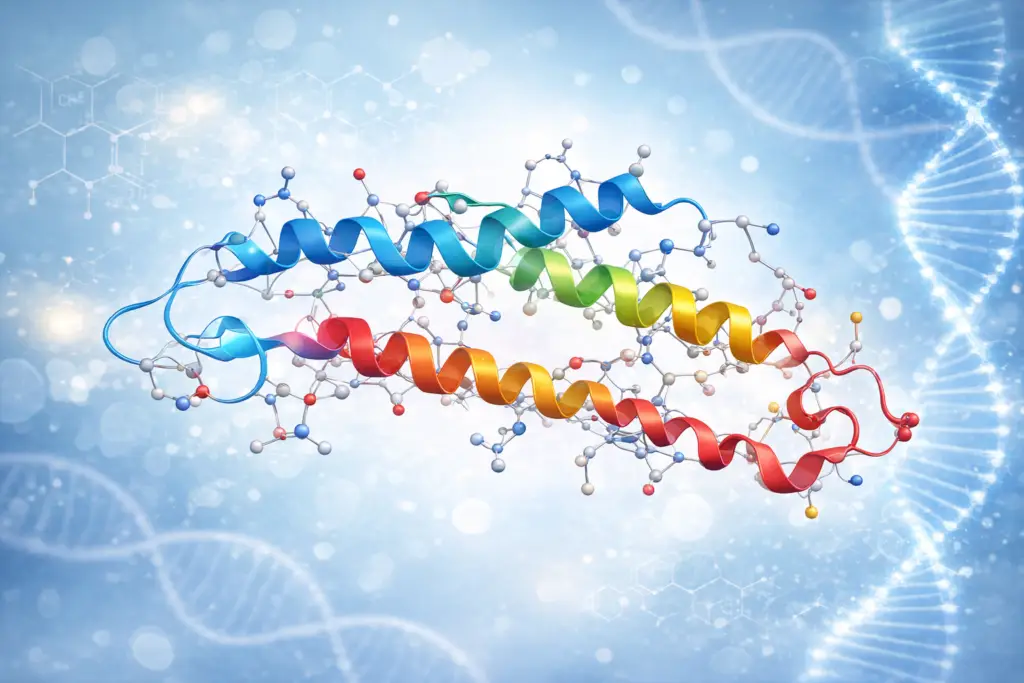
In recent years, increasing scientific attention has been directed toward hormones involved in the body’s response to food intake and energy regulation. One of the actively studied areas is the incretin system and its signaling mechanisms. This text outlines what incretins are, how their receptors function, and why the concept of dual signaling is examined in research. It is intended to support understanding of the underlying biological mechanisms within their broader scientific context.
Keywords: tirzepatide; incretins; GLP-1; GIP; hormonal signaling; receptors; dual signaling concept; biological mechanisms.
What are incretins and why are they important?
Incretins are hormones released in the gut in response to food intake. They play a role in the body’s response to nutrients and in the regulation of metabolic processes.
The two main incretins are:
- GLP-1 (glucagon-like peptide-1)
- GIP (glucose-dependent insulinotropic polypeptide)
These hormones act through specific receptors, thereby initiating intracellular signaling cascades, including cAMP-mediated pathways [1,2]. The incretin system is therefore considered an important component of metabolic regulation [1].
The concept of dual signaling
Historically, most studies have focused on the activity of a single receptor. However, biological signaling operates as an interconnected network.
The concept of dual incretin signaling is based on the premise that simultaneous interaction with GLP-1 and GIP receptors may give rise to more complex biological response patterns than the isolated activation of each receptor [2,3].
Tirzepatide is described in the literature as a synthetic peptide molecule investigated for its interaction with both GLP-1 and GIP receptors [4,5].
Molecular mechanism of action (research context)
Tirzepatide is designed to bind to both GLP-1 and GIP receptors. Upon receptor binding, intracellular signaling is initiated, involving second messengers such as cAMP [1,5].
Studies typically evaluate:
- receptor binding characteristics,
- signaling activation profiles,
- temporal dynamics of signaling,
- laboratory parameters used to characterize biological processes [4,5].
It is important to note that these mechanisms are generally analyzed in experimental systems (e.g., cell cultures and animal models), and the resulting data should be interpreted in the context of the experimental model.
Signal interactions and biological complexity
The incretin system functions as an integrated regulatory network. GLP-1 and GIP receptors may be distributed differently across tissues, and their activity may vary accordingly [2].
The biological response depends on:
- receptor balance,
- duration of activation,
- overall metabolic state,
- other concurrent hormonal signals.
In addition, the body exhibits adaptive mechanisms. Prolonged receptor activation may lead to changes in sensitivity (desensitization), while alternative signaling pathways may compensate for the initial effect [5,6].
Therefore, the effects of dual signaling cannot be interpreted as the additive effect of two independent signaling pathways.
Methodological context of research
Studies on tirzepatide and similar molecules typically analyze:
- receptor activation profiles,
- distribution-related parameters,
- signaling strength and duration,
- laboratory or molecular markers [4,5].
Different research models provide different levels of information:
- cell models allow investigation of molecular mechanisms,
- animal models provide a broader biological context,
- clinical studies evaluate processes within complex biological systems [4].
For this reason, data interpretation must therefore be inherently context-dependent.
Discussion
Tirzepatide is discussed in the literature as a model molecule used to analyze interactions between two incretin receptors [4,5].
Biological systems operate in a non-linear manner, where signals interact with one another and compensatory mechanisms may be activated. Small changes in one signaling pathway may be balanced by others.
Individual differences—genetic, metabolic, or hormonal—may also influence response patterns. Therefore, the analysis of dual incretin signaling should be regarded as a research approach aimed at understanding the complexity of hormonal regulation, rather than as a simplified representation of underlying biological processes.
Conclusions
- The incretin system is a complex hormonal regulatory network involved in the body’s response to food intake [1].
- GLP-1 and GIP act through specific receptors, thereby initiating intracellular signaling pathways [1,2].
- The concept of dual signaling is based on the study of simultaneous receptor interactions [2,3].
- Tirzepatide is described in the literature as a molecule investigated for its interaction with GLP-1 and GIP receptors [4,5].
- Different research models provide varying levels of data, and conclusions must therefore be interpreted within context [4].
- Biological processes are dynamic and depend on multiple interconnected factors [5,6].
- The study of dual incretin signaling contributes to a more comprehensive understanding of hormonal regulatory mechanisms.
References
[1] Drucker DJ. The Biology of Incretin Hormones. Cell Metabolism. 2006.
https://www.cell.com/cell-metabolism/fulltext/S1550-4131(06)00028-3
[2] Holst JJ. The Physiology of Glucagon-like Peptide-1. Physiological Reviews. 2007.
https://pubmed.ncbi.nlm.nih.gov/17928586/
[3] Baggio LL, Drucker DJ. Biology of Incretins: GLP-1 and GIP. Gastroenterology. 2007.
https://pubmed.ncbi.nlm.nih.gov/17198970/
[4] Heise T, et al. Pharmacokinetic and pharmacodynamic properties of tirzepatide. Diabetes, Obesity and Metabolism. 2021.
https://doi.org/10.1111/dom.14362
[5] Campbell JE, Drucker DJ. Pharmacology, physiology, and mechanisms of incretin hormone action. Cell Metabolism. 2013.
https://pubmed.ncbi.nlm.nih.gov/23395168/
[6] Finan B, et al. Unimolecular dual incretins maximize metabolic benefits in experimental models. Science Translational Medicine. 2013.
https://doi.org/10.1126/scitranslmed.3007218