


Informational Nature
The information provided in this text is for scientific and educational purposes. It is intended to describe molecular, cellular, and biological processes in the context of cosmetics.
The text does not discuss medical or therapeutic application. The information is based on an analysis of peer-reviewed scientific publications and is intended for a general understanding of skin biology and cosmetic formulation principles.
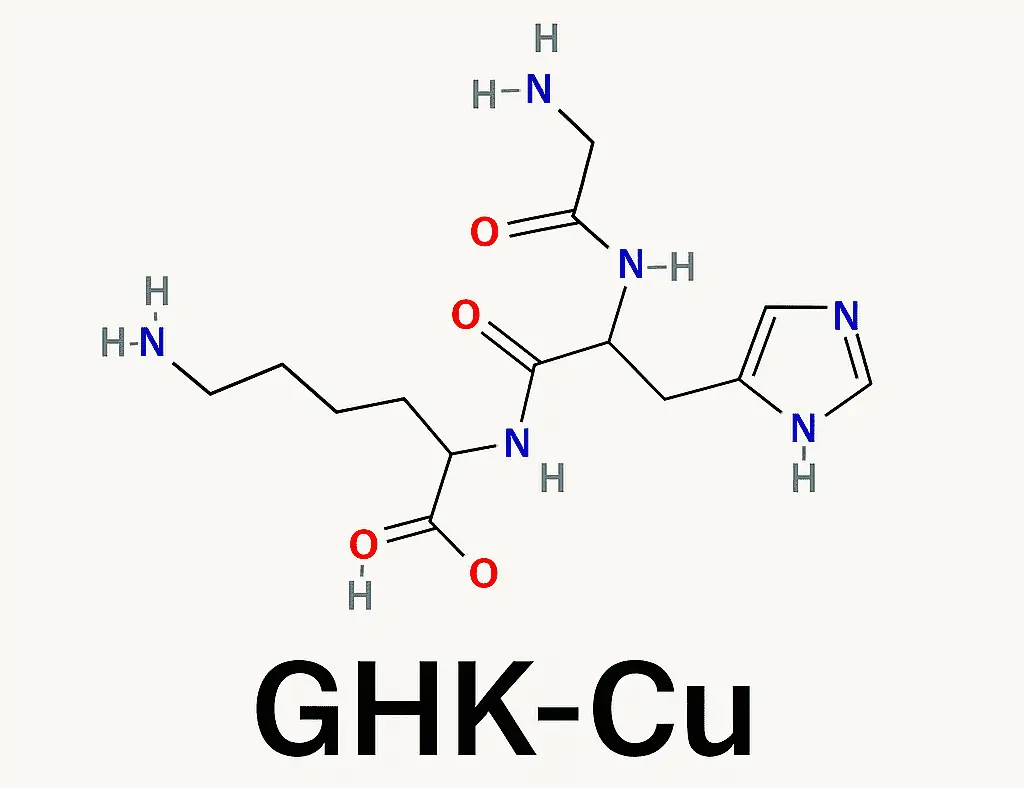
Skin biology is a complex and dynamic system where the extracellular matrix, cellular signaling, and metal ion homeostasis interact as part of an integrated regulatory network. In modern cosmetic science literature, increasing attention is being paid to bioactive peptides, which are studied for their potential interactions with structural and signaling processes in the skin.
Keywords: GHK-Cu; copper peptides; skin biology; extracellular matrix; collagen processes; cosmetic formulation.
Introduction
GHK-Cu (glycyl-L-histidyl-L-lysine–Cu²⁺) is an endogenous copper-binding tripeptide first identified in human plasma in the 1970s [1]. Later studies showed that this complex may be associated with models of extracellular matrix regulation and changes in gene expression in experimental systems [2,5].
As a result of these findings, GHK-Cu has been increasingly studied in the context of dermatological cosmetics, where it is incorporated into topical formulations designed to support skin appearance.
Molecular Structure and Chemical Properties
GHK is composed of three amino acids: glycine, histidine, and lysine. The imidazole ring of histidine coordinates the copper ion, forming a stable chelate complex [2].
In biological systems, copper ions act as cofactors in numerous enzymatic reactions, and their binding within peptide complexes is investigated in the context of metal homeostasis and cellular signaling processes [2,4].
Biological Processes in Experimental Models
1. Studies of Collagen and Matrix Components
In vitro fibroblast cultures have demonstrated changes in the expression of collagen and other extracellular matrix components associated with GHK-Cu [3,4].
These findings were obtained under controlled laboratory conditions and reflect experimental models that cannot be directly extrapolated to in vivo cosmetic outcomes in human skin.
2. Cellular Response Mechanisms
Gene expression analyses suggest that GHK may be associated with the regulation of genes involved in tissue structure and inflammatory processes [5]. Oxidative balance parameters have also been investigated in cell culture models [2].
3. Model Studies of Skin Renewal
Animal models have been used to investigate processes related to epithelial renewal dynamics and extracellular matrix organization [3,6]. These findings are considered experimental and should be interpreted in light of the inherent limitations of the model.
Clinical Observations and Limitations
Some small-scale clinical evaluations of topically applied copper peptide formulations have reported changes in skin texture, elasticity, and superficial wrinkles [4,6].
However, most of these studies are characterized by:
- limited sample sizes,
- heterogeneous evaluation methods,
- short observation periods.
Due to this methodological heterogeneity, the findings are considered preliminary and should be interpreted with appropriate caution.
Formulation Aspects: Cream and Serum
The stability of peptide compounds in cosmetic formulations depends on factors such as pH, oxidative environment, light exposure, and interactions with other ingredients [2,4].
1. Cream-type emulsions
Emulsion systems with a higher lipid content may form a protective film on the skin surface and influence moisture retention. The composition of the formulation may also affect the stability of the active ingredient.
2. Serum-type formulations
Serums typically have a lighter texture and lower lipid content. In such systems, careful pH control and protection against oxidation are essential to maintain the structural integrity of the peptide.
The properties of the final product depend on the overall formulation rather than on any single active component.
Discussion
Research on GHK-Cu encompasses multiple levels of analysis, ranging from molecular interactions to small-scale clinical cosmetic evaluations. When interpreting these data, it is important to clearly distinguish between the types of evidence and their respective limitations.
In vitro models enable the analysis of signaling pathway activation and changes in the expression of extracellular matrix components [3,5]. However, such systems do not fully replicate the complex biological environment of the skin, which involves keratinocytes, fibroblasts, immune cells, and vascular elements.
Animal models provide a broader biological context, but the translation of their findings to human skin is subject to methodological limitations [3,6]. Differences in species, experimental conditions, and applied concentrations may influence the observed outcomes.
Clinical cosmetic studies often rely on instrumental and visual assessment methods, the sensitivity and standardization of which may vary [4,6]. In addition, short observation periods limit the evaluation of long-term processes.
Formulation technology is also a critical factor. Peptide stability may be affected by oxidation, metal ion balance, and interactions with other ingredients [2,4]. Therefore, even when experimental data on the biological activity of a molecule are available, the properties of the final cosmetic product depend on its formulation and technological implementation.
Within the context of cosmetic regulation, it is essential to clearly distinguish aesthetic purposes from medical applications. Scientific data on molecular processes cannot be directly interpreted as therapeutic claims.
In summary, GHK-Cu is described in the literature as a biologically active copper complex in experimental systems; however, clinical cosmetic evidence remains limited and methodologically heterogeneous. Its evaluation in the field of cosmetics should be based on a balanced and context-dependent interpretation of scientific data.
Conclusions
- GHK-Cu is a copper-binding tripeptide studied for its potential interactions with extracellular matrix components and cellular processes [1–5].
- Experimental models indicate biological activity; however, clinical cosmetic evidence remains limited and heterogeneous [4,6].
- In cosmetic formulations, GHK-Cu is used as an active ingredient whose stability and functional characteristics are determined by formulation design and technological factors.
References:
[1] Pickart L, Thaler MM. Tripeptide in human serum which prolongs survival of normal liver cells and stimulates growth in neoplastic liver. Nature New Biology. 1973.
https://pubmed.ncbi.nlm.nih.gov/4353652/
[2] Pickart L. The human tri-peptide GHK and tissue remodeling. Journal of Biomaterials Science. 2008.
https://pubmed.ncbi.nlm.nih.gov/18855178/
[3] Maquart FX, et al. Stimulation of collagen synthesis in fibroblast cultures by the tripeptide-copper complex GHK-Cu. FEBS Letters. 1988.
https://pubmed.ncbi.nlm.nih.gov/2963197/
[4] Finkley MB, et al. Copper peptide and skin regeneration research. International Journal of Cosmetic Science. 1998.
https://pubmed.ncbi.nlm.nih.gov/18498452/
[5] Pickart L, Margolina A. Regenerative and protective actions of the GHK-Cu peptide in the light of the new gene data. International Journal of Molecular Sciences. 2018.
https://www.mdpi.com/1422-0067/19/7/1987
[6] Leyden J, et al. Clinical evaluation of copper peptide formulations in photoaged skin. Dermatologic Surgery. 2002.
https://pubmed.ncbi.nlm.nih.gov/11896779/